
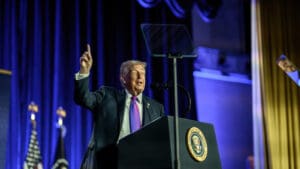
President Donald Trump’s decision to raise US tariffs to 15 per cent has drawn sharp warnings from British business leaders, who say the move risks harming thousands of UK exporters and slowing global economic growth.
In a social media post on Saturday, Trump said he was “effective immediately” raising the existing 10 per cent worldwide tariff on countries to the “fully allowed” 15 per cent level. The announcement followed a ruling by the US Supreme Court that the president had exceeded his authority by using emergency powers to impose tariffs on dozens of trading partners, including the UK.
The revised measure, introduced under alternative legislation, would increase tariffs on many British goods by a further 5 percentage points unless covered by existing exemptions.
The British Chambers of Commerce (BCC) said the change would affect around 40,000 UK firms exporting to the US.
William Bain, the BCC’s head of trade policy, said: “We had feared that the president’s plan B response could be worse for British businesses, and so it is proving. An extra 5 per cent increase on a wide range of UK exports will be bad for trade, bad for US consumers and weaken global growth.”
He added that businesses on both sides of the Atlantic needed clarity and stability rather than further disruption.
The UK government is engaged in high-level talks with Washington in an effort to preserve preferential arrangements under the UK-US Economic Prosperity Deal (EPD), announced in May last year by Trump and Keir Starmer.
Bridget Phillipson acknowledged the uncertainty facing exporters but insisted the UK expected its preferential trading arrangements to continue. “We want the best possible deal for British businesses,” she said.
The new 15 per cent levy represents the maximum allowed under Section 122 of the US Trade Act of 1974 and will apply for up to 150 days. Economists estimate the effective US tariff rate could rise back to around 14.5 per cent, reversing some of the reductions seen in recent weeks.
Paul Ashworth, chief North America economist at Capital Economics, suggested revenue considerations may have influenced the decision, noting that higher tariffs generate greater customs income. He added that because Section 122 requires non-discriminatory application, countries such as the UK may lose any preferential advantage previously secured.
The Supreme Court ruling has left billions of dollars in tariff revenues potentially in dispute, with US importers seeking refunds. Meanwhile, India has postponed a planned trade mission to Washington amid uncertainty over US trade policy.
Business groups warn that renewed tariff escalation could disrupt supply chains and investment decisions at a time when global growth is already fragile.
For UK exporters, particularly those outside the scope of the EPD, the immediate concern is a sudden rise in costs for access to one of Britain’s largest overseas markets.
Read more:
Trump’s new 15% tariff plan ‘will hit UK exporters and dent global growth’